- aofsoman@omantel.net.om
- +968 24724700

MANAGEMENT DISCUSSION AND ANALYSIS REPORT
OVERVIEW
Al Omaniya Financial Services (AOFS) has completed 23 years of successful operations as a Non-Banking Financial Institution, offering a comprehensive range of financial products. Over its tenure of more than two decades, the company has established a strong market presence with good systems and processes and has crossed many significant milestones.
The following discussion and analysis provide information that the management believes, is useful in understanding AOFS’s operating results and financial position. The discussion is based on AOFS’s continuing operations and should be read in conjunction with our consolidated financial statements and related notes appearing elsewhere in this report.
Certain statements in the MD&AR describing the company’s views, objectives, projections, estimates, expectations, etc. may be extrapolative within the ambit of applicable laws and regulations. Actual results could differ materially from those expressed or implied. Important factors like changes in government regulations, tax laws, interest rates in the domestic and international markets, demand and supply of capital goods, etc. may influence the company’s operating results.
WORLD ECONOMIC OUTLOOK
As we enter the year 2020, global growth is projected to rise from an estimated 2.9 percent in 2019 to 3.3 percent in 2020 and 3.4 percent for 2021. The effects of substantial monetary easing across advanced and emerging market economies in 2019 are expected to continue working their way through the global economy in 2020. For the emerging market and developing economies, growth is expected to increase to 4.4 percent in 2020 and 4.6 percent in 2021 from an estimated 3.7 percent in 2019.
The risk of protracted sub-par global growth remains tangible despite tentative signs of stabilizing momentum and the following downside risks remain prominent:
► Rising geopolitical tensions, notably between the United States and Iran
► Higher tariff barriers between the United States and its trading partners, notably China
► Deepening crisis of the Corona Virus outbreak in China impacting the global supply chain, because of which the World Bank has decided to lower its growth forecast and OPEC has also trimmed 2020 demand forecast
► Weather-related disasters such as tropical storms, floods, heatwaves, droughts, and wildfires which have imposed severe humanitarian costs and livelihood loss across multiple regions in recent years
The above factors have an impact in reduction of capital inflow, higher financing costs, and exchange rate pressures.

DOMESTIC ECONOMY
Oil & Gas continue to be the major revenue source of Oman economy. Oman’s credit ranking was affirmed at BB/B by S&P Global Ratings which has cautioned a negative outlook for the Sultanate for a continuing reliance on hydrocarbon products. IMF said that crude oil as strategic commodity faces numerous challenges because of the progress made in energy alternatives and more boost towards renewable energy.
S&P said they could lower the ratings on Oman further over the next 12 months if they perceive that the external debt accumulation is leading to a sizable fiscal deficit. The economy performed moderately in 2018 and 2019 as higher average oil and gas prices, coupled with increased hydrocarbon output, translated into stronger public finances and export growth. The average realized price of oil for 2019 was USD $64/bbl against a budget of USD $58/bbl.
The budget for the year 2020 has been pragmatic with the government’s continued focus on controlling deficit, which is expected to decline by 11% from OMR 2.8 billion in 2019 to OMR 2.5 billion in 2020. Expenditure is kept under control with a budgeted increase of only 2%, attributable to an increase in interest cost on borrowings. The budget seeks to continue to spur the national economy by maintaining investment and spending levels, and also supporting economic diversification policy through expanding the participation of private sector for them to play a greater role in the economy and create more job opportunities.
The banking sector has recorded weakness and credit growth fell to 3 percent in 2019 as against 6 percent in the previous year coupled with higher delinquency and decreased international ratings. By employing robust yet flexible strategies under the governance of the Central Bank of Oman, the sector has delivered a moderate performance defined by best practice.
NON BANKING FINANCE COMPANIES SECTOR
The industry has faced major challenges during the year 2019, apart from the reduction in quality credit offtake in addition to competition from commercial banks and Islamic banks including the Islamic windows of commercial banks in the retail and SME segment. To meet the regulatory requirements, the banks were also aggressive in the SME Segment and they have managed to wean away customers in this segment from NBFCs bringing down both the credit quality and yields. The NBFCs also witnessed tightening of liquidity in the market leading to increase in the cost of funding.
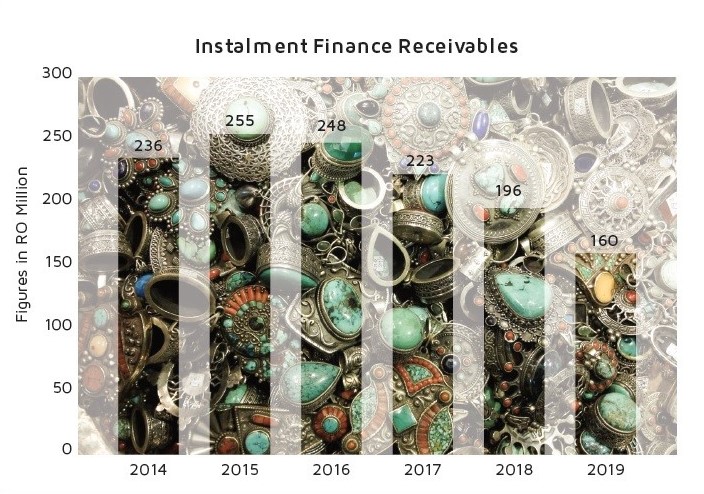
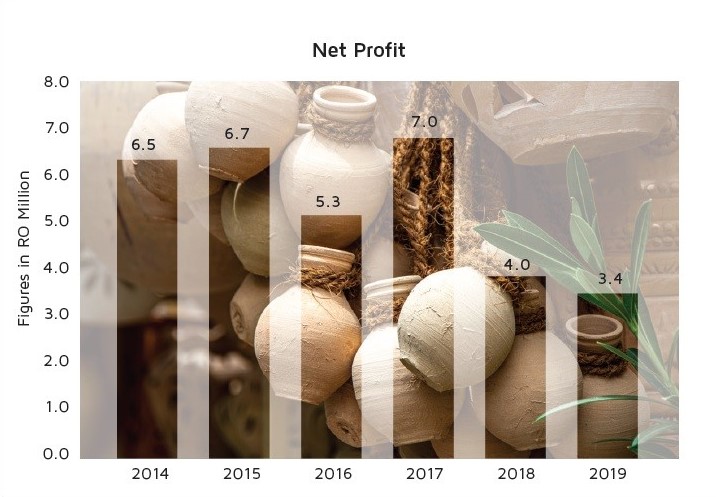
Oman’s non-banking finance companies are undergoing challenging times as the slowdown in their asset growth, declining margins and increasing non-performing loans has put further pressure on their profitability. Going forward, the low credit offtake combined with the increasing funding cost, reduced margins, and increasing NPLs may put pressure on the profitability of the NBFCs and they may find it increasingly challenging to maintain the level of profitability unless the economic situation improves.
OPPORTUNITIES AND THREATS
Maintaining Asset Quality has been the primary focus of the company. There has been cash flow distress with major contracting companies. The delay in government spending and the slowdown in project payments has impacted the cash flows of the major contracting firms as well as sub-contractors trickling down the line at the individual level as well. This has resulted in a major systemic risk in the financial system leading to deterioration in the asset quality, restrictive credit sanctioning, increase in the-non-performing loans and higher provision requirement for bad and doubtful debts. Hence, the company has been very cautious in writing business this year.
The fiscal and economic policies of the government for the year 2020 are prudent and forward looking. With expected release of funds for completed projects and some new spending on infrastructure and tourism sector, the economic activities are expected to improve the optimism.
The fiscal and economic policies of the government for the year 2019 are prudent and forward looking. With expected release of funds for completed projects and some new spending on infrastructure and tourism sector, the economic activities are expected to improve the optimism.